An error occurred. Details Hide
You have unsaved pages. Restore Cancel

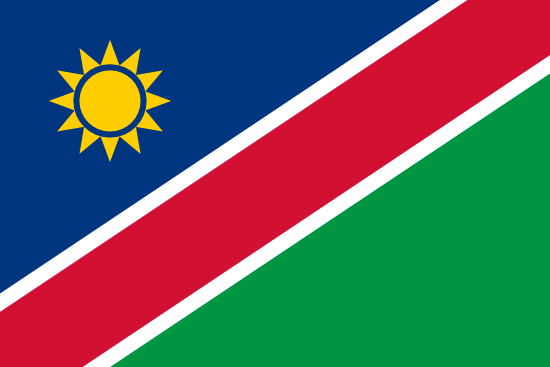
Namibia

  • President:Hage Geingob
  • Prime Minister:Saara Kuugongelwa-Amadhila
  • Capital city:Windhoek
  • Languages:Oshiwambo languages 48.9%, Nama/Damara 11.3%, Afrikaans 10.4% (common language of most of the population and about 60% of the white population), Otjiherero languages 8.6%, Kavango languages 8.5%, Caprivi languages 4.8%, English (official) 3.4%, other African languages 2.3%, other 1.7% note: Namibia has 13 recognized national languages, including 10 indigenous African languages and 3 Indo-European languages (2011 est.)
  • Government
  • National statistics office
  • Population, persons:2,533,794 (2017)
  • Area, sq km:823,290 (2017)
  • GDP per capita, US$:5,227 (2017)
  • GDP, billion current US$:13.2 (2017)
  • GINI index:61 (2009)
  • Ease of Doing Business rank:106 (2017)

All datasets: A C G I O T W
  • A
  • C
    • October 2017
      Source: Organisation for Economic Co-operation and Development
      Uploaded by: Knoema
      Accessed On: 30 November, 2017
      Select Dataset
      The objective of the CRS Aid Activity database is to provide a set of readily available basic data that enables analysis on where aid goes, what purposes it serves and what policies it aims to implement, on a comparable basis for all DAC members. Data are collected on individual projects and programmes. Focus is on financial data but some descriptive information is also made available.
  • G
  • I
    • December 2010
      Source: Institute for Health Metrics and Evaluation
      Uploaded by: Balaji S
      Select Dataset
      IHME results from paper, Public financing of health in developing countries: a cross-national systematic analysis published in The Lancet in April 2010. This dataset provides estimates on domestically financed government health expenditures in developing countries and development assistance for health (DAH) to governmental and non-governmental recipients from 1995 to 2006.
  • O
    • June 2017
      Source: Organisation for Economic Co-operation and Development
      Uploaded by: Knoema
      Accessed On: 29 June, 2017
      Select Dataset
      Other official flows are official sector transactions which do not meet the ODA criteria, e.g.: i.) Grants to developing countries for representational or essentially commercial purposes; ii.) Official bilateral transactions intended to promote development but having a grant element of less than 25 per cent; iii.) Official bilateral transactions, whatever their grant element, that are primarily export-facilitating in purpose. This category includes by definition export credits extended directly to an aid recipient by an official agency or institution ("official direct export credits"); iv.) The net acquisition by governments and central monetary institutions of securities issued by multilateral development banks at market terms; v.) Subsidies (grants) to the private sector to soften its credits to developing countries [see Annex 3, paragraph A3.5.iv)b)]; vi.) Funds in support of private investment.
  • T
    • November 2018
      Source: Organisation for Economic Co-operation and Development
      Uploaded by: Knoema
      Accessed On: 26 November, 2018
      Select Dataset
      Total Receipts, Net: in addition to Official Development Assistance, this heading includes in particular: other official bilateral transactions which are not concessional or which, even though they have concessional elements, are primarily trade facilitating in character (i.e., "Other Official Flows''); changes in bilateral long-term assets of the private non-monetary and monetary sectors, in particular guaranteed export credits, private direct investment, portfolio investment and, to the extent they are not covered in the preceding headings, loans by private banks. Flows from the multilateral sector which are not classified as concessional are also included here.
  • W
    • May 2017
      Source: United Nations Department of Economic and Social Affairs
      Uploaded by: Knoema
      Accessed On: 03 August, 2017
      Select Dataset
      The 2017 Revision of World Population Prospects is the twenty-fourth round of official United Nations population estimates and projections that have been prepared by the Population Division of the Department of Economic and Social Affairs of the United Nations Secretariat. The main results are presented in a series of Excel files displaying key demographic indicators for each development group, income group, major area, region and country for selected periods or dates within 1950-2100. A publication labelled Key findings and advance tables, which provide insights on the results of this latest revision, is also made available here.
    • June 2015
      Source: United Nations Department of Economic and Social Affairs
      Uploaded by: Balaji S
      Accessed On: 01 August, 2015
      Select Dataset
      The Population Division of the Department of Economic and Social Affairs of the United Nations has been issuing, since 1988, every two years revised estimates and projections of the urban and rural populations of all countries in the world and of their major urban agglomerations. This web site presents the main findings of the 2014 Revision of World Urbanization Prospects which are consistent with the size of the total population of each country as estimated or projected in the 2012 Revision of World Population Prospects(United Nations, 2013). The World Urbanization Prospects are used widely throughout the United Nations and by many international organizations, research centers, academic researchers and the media.

Our Privacy Statement & Cookie Policy

Our website uses cookies to improve your online experience. They were placed on your computer when you launched this website. You can change your personal cookie settings through your internet browser settings.

Privacy Policy